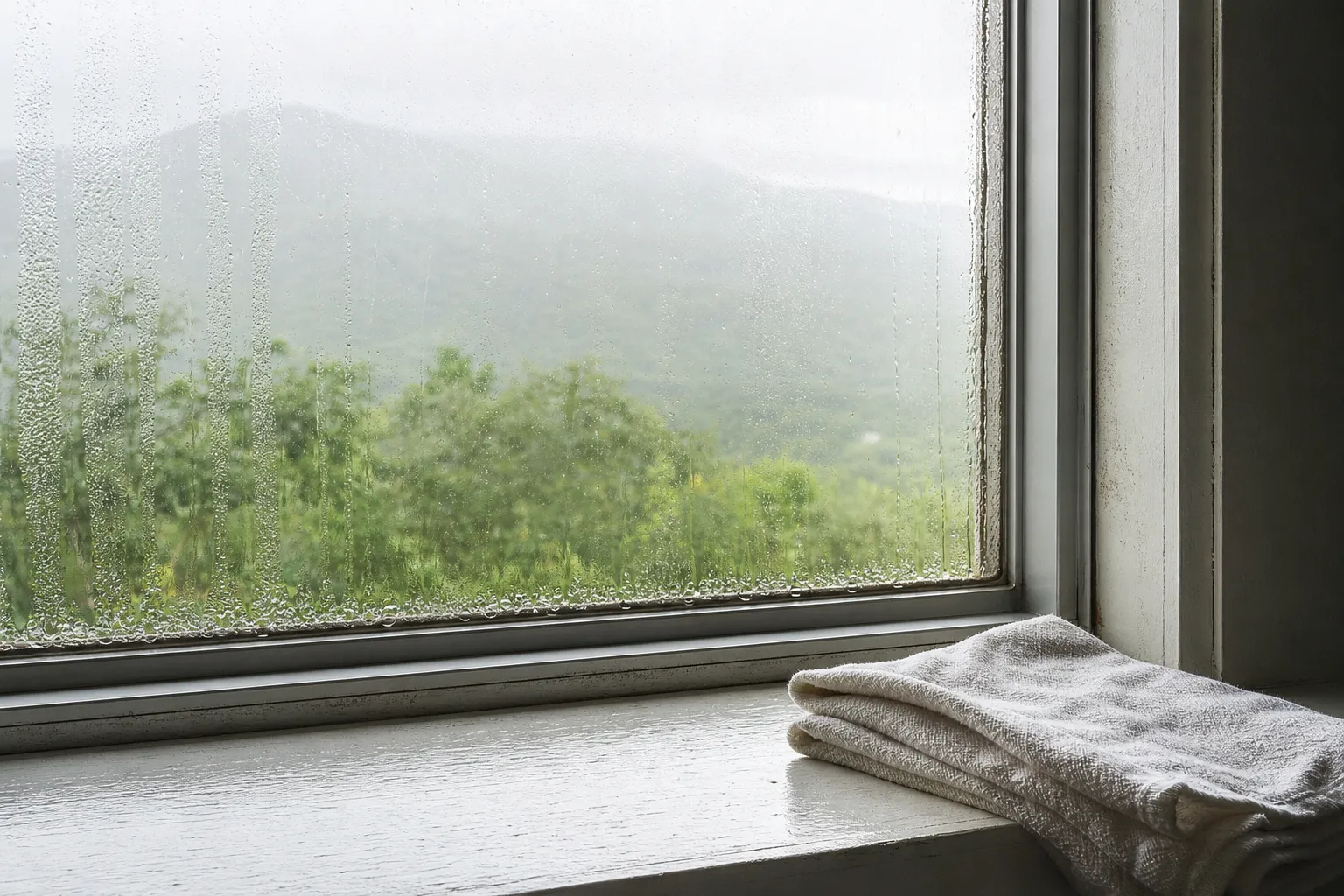
Condensation forms when moist indoor air touches glass that is colder than the air's dew point. Cut the moisture first: use exhaust fans that vent outside, dry clothes outdoors and avoid unflued gas heaters. Then air the house on dry days, wipe the glass and tracks in the morning, keep weep holes clear and, if the problem is every night, look at warmer glazing or frames.
Why water appears on the inside of the glass
Air always carries some water vapour, and warm air can carry more of it than cold air. When room air meets a surface colder than itself, it cools, and below a certain temperature it can no longer hold all its moisture. That temperature is the dew point, and the water that drops out is condensation.
The Australian Government's Your Home guide gives a sense of how close the line is. Air at 20 °C with 80% relative humidity has a dew point of about 17 °C. In other words, in a humid room, any surface just a few degrees cooler than the air will start to collect water. On a winter night, single glass in an aluminium frame can easily be that much colder than the room behind it.
Windows are the usual place you see it because glass and aluminium are the coldest surfaces in most rooms. The same thing can happen out of sight, on the back of a wardrobe pushed against an outside wall, in a corner behind furniture, or inside a wall or ceiling. Your Home calls that hidden version interstitial condensation, and it is the kind that leads to rot.
Why it happens in Queensland at all
Most of coastal south-east Queensland, including the Sunshine Coast, sits in National Construction Code climate zone 2: warm humid summers and mild winters. Your Home rates the winter condensation risk in zone 2 as "some", not high. That is true on average, but averages hide the hinterland.
Ranges such as the Blackall Range are cooler than the coast, and clear, calm winter nights let heat radiate away from the house quickly. Inside, the air is still humid from the day, from showers and cooking, and from everyone breathing in a closed-up house. Put those together and the glass in a bedroom can pass the dew point well before dawn.
Summer has its own version. In a hot, humid climate, an air-conditioned room can cool walls and glass below the dew point of the muggy air outside, and Your Home warns that this can cause condensation inside the building structure. If you notice damp or mould behind furniture in summer rather than winter, that is the more likely cause.
Where the moisture comes from
You cannot change the weather, but most of the water vapour in a house is produced by the people living in it. Your Home lists the everyday sources:
- Breathing. Every person adds moisture all night, which is why bedrooms with the door shut are often the worst rooms.
- Showers and baths, especially with the exhaust fan off or venting into the roof space.
- Cooking without a rangehood that vents outside.
- Drying clothes indoors on racks or in a dryer that is not vented outside.
- Burning gas on a cooktop or in a heater. An unflued gas heater puts the water vapour from combustion straight into the room.
Older houses with gaps around doors and windows let some of this moisture leak away. Newer, better-sealed homes keep the heat in but keep the moisture in too, so they need ventilation that is designed rather than accidental.
Do blinds and curtains make it worse?
Window coverings cut both ways. Your Home notes that curtains with a pelmet trap a layer of still air next to the glass, and heavy or layered fabrics reduce the heat flowing out through the window. That makes the room warmer, which is good.
The catch is that the glass behind a closed blockout blind or a heavy curtain gets colder, because the room's heat no longer reaches it. Moist air that slips into that gap from the sides or the bottom meets very cold glass. That is why many people find the most water behind the bedroom blind on the coldest mornings.
- Choose coverings that fit closely and stop air circulating behind them, such as a curtain with a pelmet or a blind fitted inside the reveal, rather than a loose fabric that lets room air slide past.
- Open blinds and curtains in the morning so the glass can warm and dry, and leave them open on sunny days.
- Do not leave fabric touching wet glass. Damp fabric on a cold sill is where mould starts, and it stains.
- Shutters and venetians allow more air movement than a blockout roller blind. Our shutters vs venetians guide covers how each copes with humidity.
Fixes that cost little or nothing
Start with the cheapest steps. In most Queensland homes, these are enough.
- Run exhaust fans during showers and cooking and for a while afterwards. Check that the fans vent outdoors; Your Home specifically recommends venting bathroom, laundry and kitchen exhaust directly outside.
- Dry clothes outside whenever the weather allows.
- Air the house on dry days by opening windows on opposite sides for cross-ventilation, even for half an hour.
- Wipe the glass and frames in the morning with an absorbent cloth or a squeegee, and empty the sliding door and window tracks.
- Keep weep holes clear. The small slots at the bottom of aluminium frames let water drain from the track. When they block, the track overflows onto the sill and floor.
- Move furniture a few centimetres away from cold outside walls so air can circulate behind it.
- Avoid unflued gas heaters. Use a flued heater, a reverse-cycle air conditioner or another heater that does not release combustion moisture into the room.
A small dehumidifier can help in a bedroom or a closed-up room. Your Home also notes that an air conditioner that is correctly sized removes moisture as it runs; an oversized unit can switch off before it has done so.
When to upgrade the window itself
If the glass runs with water every winter night despite all of the above, the window is the weak point. Aluminium is a very good conductor of heat, and Your Home describes aluminium frames as a thermal bridge that is prone to condensation.
The options, roughly from cheapest to most expensive:
- Retrofit secondary glazing, a second pane fitted inside the existing window.
- Double glazing in the existing opening. The warmer inner pane sits further above the dew point.
- Less conductive frames: thermally broken aluminium, uPVC or timber. Your Home's comparison table shows a timber or uPVC double-glazed window losing roughly half the heat of single glass in plain aluminium.
Replacing windows in an existing house may involve building work that needs a licensed contractor, particularly where the opening or flashing changes. Our Find a trade page explains how to check a QBCC licence, and any glazing should be installed to the manufacturer's instructions so the flashing still keeps rain out.
Cleaning up mould safely
Where water has sat on the sill for a few weeks, mould usually follows. The Queensland Government's advice on mould is practical:
- Do not scrub mould dry with a brush; it releases spores into the air.
- Household detergents or a white vinegar solution are effective on hard surfaces. Bleach is not recommended as a mould killer, and cleaning products should never be mixed.
- Wear rubber gloves and eye protection, and a properly fitted P2 (N95) respirator if there is a lot of mould or you have allergies.
- When repainting, an anti-mould additive in the paint can slow regrowth.
If mould keeps coming back within days of cleaning, or appears on the wall below the window rather than on the glass and sill, the water may be coming from a leak rather than from condensation. Our guide to mould around window frames explains how to tell the difference.
Common questions
Is condensation on the inside of windows a sign of a leak?
Usually not. Water spread evenly over the glass on cold mornings is condensation. Water that appears after rain, or damp and staining on the wall beside or below the frame, points to a leak in the flashing, sealant or a pipe.
Is it normal to get window condensation in Queensland?
It is less common than in southern states, but it happens, especially in cooler hinterland areas, in bedrooms with the door closed, and in homes with single glass in aluminium frames.
Will a dehumidifier stop window condensation?
It lowers the humidity in the room, which raises the gap between the air and the dew point. It works best in a closed room alongside exhaust fans and airing the house.
Should I leave a window open at night?
A small opening on a dry night lets moist air out and often stops condensation, but it lets heat out too. Running exhaust fans and keeping indoor humidity down is usually a better first step.
Does double glazing stop condensation completely?
It greatly reduces it on the inner pane, because that glass stays warmer. In very humid rooms some condensation can still form at the edges of the frame.
Sources
- Your Home (Australian Government): Condensation
- Your Home (Australian Government): Glazing
- Your Home (Australian Government): Ventilation and airtightness
- Australian Building Codes Board: Condensation in buildings handbook
- Business Queensland: Building in Queensland's climate zones
- Queensland Government: Mould
This guide is general information for Queensland homes. It does not replace an inspection or advice from a licensed tradesperson.